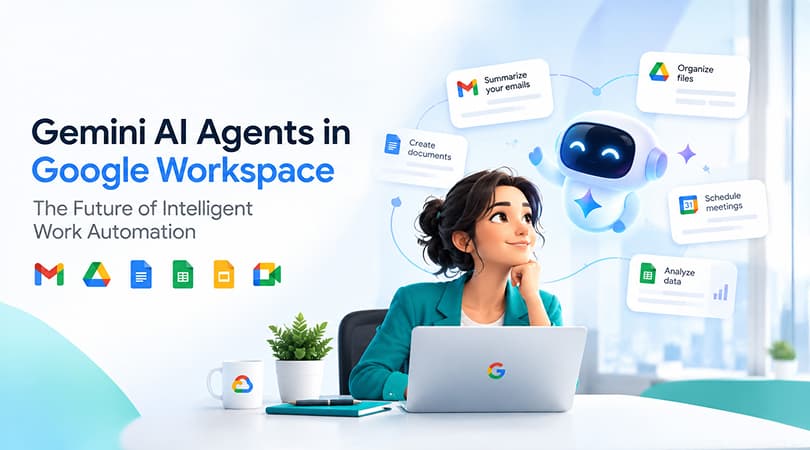
The corporate environment is entering an era where AI not only generates replies or produces content. By 2026, AI will become much more meaningful for companies in terms of task handling, data connection, and performing actions. The core of these changes is Gemini AI agents, which represent Google's strategy of enhancing AI-based work automation.
Google Workspace integrates corporate apps such as Gmail, Google Drive, Docs, Sheets, Slides, Chat, and Calendar. With the addition of Gemini into these apps, employees will stop doing repetitive tasks and will spend more time on strategic thinking, collaboration, and idea generation.
The shift in Gemini AI technology is Important because people now provide a general goal to the AI and do not ask for the performance of tasks. Google's updates in 2026 indicate the future trend where intelligent agents perform their work in programs while remaining within the corporate security and permission framework.
What Are Gemini AI Agents?
Gemini AI agents are AI-powered systems developed to analyse objectives, reason through tasks, and help execute workflows at varying levels of autonomy. Unlike a conventional chatbot that mainly responds to prompts, an agent combines data gathering, decision-making, and actions across connected tools.
For example, a project manager arranging a product launch requires changing emails, consolidating feedback, updating a spreadsheet, preparing a presentation, and coordinating meetings. Rather than handling each step independently, the user increasingly depends on Gemini to coordinate parts of this process.
The capabilities of AI agents within Gemini depend on the product, its integrations, user rights, and administrator configuration. AI is increasingly getting involved in day-to-day business activities.
How Gemini Agentic AI Is Transforming Google Workspace
Gemini connects Gmail with other Google Workspace apps to streamline communication and task management. It helps teams monitor action items, prepare follow-ups, and improve collaboration while reducing manual work and saving valuable time.
1. Smarter Email Management with Gmail
Email remains one of the biggest sources of workplace distraction. Gemini helps users summarise conversations, identify essential data, draft responses, and manage communication.
With agent-powered workflows, companies take this further by identifying emails containing action items, labeling priority messages, and arranging follow-up communications.
For example, a customer support team uses an automated workflow to identify incoming requests, extract relevant details, and prepare responses for change. This helps reduce repetitive work while ensuring employees remain responsible for sensitive or complex decisions.
2. Intelligent Document Creation in Google Docs
Document preparation for a business includes collecting data from various sources before drafting.
The Gemini application assists in summarising the reference material, structuring the report, modifying writing, and turning pieces of data into useful information. With greater integration into the Workspace, it helps collect the necessary context from emails, files, and allowed conversations.
For example, when a marketing team is arranging a campaign proposal, Gemini will help with conducting research, setting out campaign objectives, drafting the proposal, and developing supporting documents.
3. Data Analysis and Reporting in Google Sheets
Data analysis involves a lot of repetitive work, such as preparing spreadsheets, creating formulas, and generating reports. Gemini assists users in getting insights about datasets, creating formulas, managing datasets, and detecting trends. Agentic workflows go one step further by integrating data collection and reporting.
4. Linked Collaboration Among Workspaces
Among the essential advancements in Gemini at work is the ability to collaborate on tasks across multiple applications.
One business goal involves collaboration in email, meeting arrangements, documents, spreadsheets, and discussion forums. By integrating these channels within authorised parameters, Gemini users reduce context switching and ensure continuity.
Google's September 2026 announcement about Workspace Brief stated that its agentic abilities now include cross-application completion, which involves creating documents, spreadsheets, and presentations based on users' instructions.
Thus, the concept of Workspace is transformed from being a set of separate productivity apps into a connected space for intelligent work.
Google Workspace Studio: Creating Your Own AI Agents
The world of automation does not only consist of pre-configured AI features. Businesses require the ability to create agents tailored specifically to their internal operations.
With Google Workspace Studio, one can develop, manage and share AI agents in Workspace. One describes their automation goals in plain language or starts from a template, and then creates workflows based on the available actions and integrations.
It makes the concept of Gemini AI Agent Builder highly relevant for businesses wishing to customise automation without requiring everyone
Potential use cases include:
Email automation: Identify messages that require attention and apply relevant labels.
Meeting follow-ups: Summarise meeting information and prepare action items for the team to check.
Document Management: Route attachments and data to appropriate Drive folders.
Customer operations: Categorise incoming requests and prepare structured summaries.
Project coordination: Consolidate updates and support teams in preparing status reports.
Workspace Studio supports extending workflows via available connectors and custom integrations, allowing businesses to connect Workspace processes to other business applications.
The key advantage is accessibility: teams start with manageable workflows and gradually introduce more automation as their needs change.
Gemini Spark: The Next Step Toward Proactive AI Assistance
Another important feature in Google’s AI ecosystem is Gemini Spark, an AI agent designed to help people complete digital tasks.
Unlike a regular Gemini chatbot AI system, which operates on a question-and-answer basis, an agentic system performs some tasks in the background without requiring direct user interaction, within the limits of its capabilities.
Gemini Spark, a 24/7 AI agent launched by Google in 2026, became available to eligible subscribers in India. It will offer some benefits by combining Workspace tools, allowing people to manage information and complete daily digital tasks more efficiently.
A Gemini Spark agent helps users stay on top of essential communications, manage data, and coordinate digital tasks. For professionals managing busy schedules, this model points toward a future in which AI helps maintain continuity between individual tasks rather than simply responding to isolated requests.
Companies should distinguish between consumer-oriented personal agents, Workspace automation tools, and enterprise agent capabilities. Their availability, administrative controls, and supported actions may differ.
Benefits of AI Agents in the Modern Workplace
Implementing AI agents can lead to tangible operational gains if companies find suitable use cases and have proper controls.
Increased efficiency: Automating repetitive administrative work gives employees more time to focus on strategic and innovative activities.
By automating repetitive tasks and improving team productivity, Gemini AI for small businesses can help companies reduce manual work and gain a competitive advantage.
Access to information: With the use of AI, people can easily search and summarise information within business content.
Greater consistency in workflow: Standardised workflows will minimise potential errors and increase efficiency.
Collaboration: Using agents, coordination of documentation, and follow-up activities can be performed much faster.
More flexible automation: Automation can be used not only by technical staff but also by regular employees, using natural-language commands and standardising workflows.
All these advantages will be achieved in the case of proper implementation, use by employees, and actual results. Companies need to measure time savings, error rates, workflow efficiency, and employee satisfaction.
Security, Governance, and Responsible AI
More freedom necessitates better governance. Companies need to ensure that their AI agents operate under appropriate permissions and do not disclose any confidential information or engage in any unauthorised activity.
Google’s new Workspace strategy is based on current security and administration controls, while its 2026 strategy focuses on governance, identification and authorisation of agentic systems.
The policy should encompass such aspects as:
Access to sensitive documents, emails, and customer data.
Approval of important outside actions by humans.
Checking the content and analytical results provided by AI.
Monitoring, auditing, and governance of automated work processes.
Appropriate employee training and proper data handling.
This approach treats AI agents as controlled digital helpers rather than all-knowing decision-makers. Human supervision is required for financial commitments, legal issues, customer communication, and many other important tasks.
The Future of Intelligent Work Automation in 2026 and Beyond
The subsequent step in the evolution of workplace AI will be characterised by connected systems that understand context, synchronise processes, and facilitate goal achievement through applications.
Along with adopting AI-powered automation, businesses should also evaluate to build a scalable and cost-effective digital Google Workspace pricing and branding strategies workplace.
With the ongoing development of Gemini, one anticipates that the agentic approach will affect how work with information is created, analysed, and collaborated on within Google Workspace products. Applications like Workspace Studio serve as a first step in this process, whereas Gemini Spark demonstrates the growing interest in proactive support for people with AI.
Businesses are advised to begin with low-risk, well-defined workflows, assess results, and then proceed to gradual automation. The combination of valuable AI capabilities, sound governance, and employees' knowledge is crucial for successful intelligent work.
Conclusion
The Gemini AI chatbots for Google Workspace 2026 are a significant step towards an office environment where AI assists in coordinating and performing tasks rather than merely providing answers. With tools like Gmail, Docs, Sheets, Workspace Studio, and even Gemini Spark.
The future of intelligent automation will not depend solely on AI. It will rather be determined by how successfully enterprises integrate the capabilities of agents, credible business information, security measures, and human intuition. For companies looking to prepare digital work in the next era, it might be a good idea to try Gemini automation now.
Businesses looking to implement these solutions can explore Google Workspace services to support their collaboration, productivity, and migration requirements.